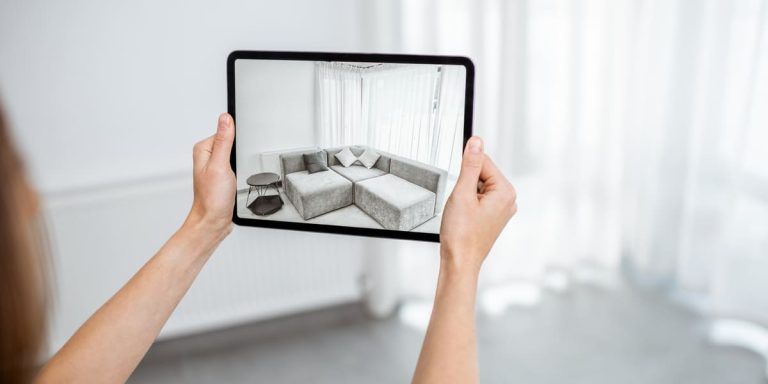
Augmented reality in commerce is easy to overhype. The stronger question is simpler: does it help people understand, evaluate, or engage with a product more clearly than static media can?
That is where retail and interactive-marketing use cases become meaningful. AR can place a product in context, let a person preview fit or scale, turn a campaign into an explorable experience, and shorten the distance between curiosity and action. When that happens, it stops behaving like spectacle and starts behaving like commercial infrastructure.
Why AR matters in retail
Retail always has an explanation problem. The customer needs to understand a product well enough to feel confident buying it without touching it first.
AR helps reduce that uncertainty by making the product more legible:
- placing products in real space
- previewing fit, scale, or appearance
- showing product features in a more interactive way
- creating more memorable campaign touchpoints
That matters for e-commerce and physical retail alike. In both cases, the commercial value comes from reducing ambiguity and increasing confidence.
Interactive marketing works when the interaction has a point
AR campaigns tend to perform best when the interaction is tied to a real marketing objective. That may be product education, higher engagement, stronger recall, or easier conversion into the next step.
The weak version of interactive marketing uses AR only to attract attention. The stronger version uses it to make the message easier to understand and harder to forget.
That is why AR works especially well for:
- product launches
- in-store activation
- experiential campaign layers
- branded storytelling
- explorable packaging or display moments
If the interaction helps the audience make sense of the brand or product faster, the experience has commercial value. If it only feels flashy, the effect usually fades quickly.
Retail visualization is more than a gimmick
One of the most durable AR use cases in retail is product visualization. When buyers can see how an item fits into their environment or onto themselves, decision friction drops.
That is the same commercial logic behind browser-based shopping previews and virtual try-ons. The difference is format, not principle. In all of these cases, AR improves decision quality by making the product easier to inspect before purchase.
For that reason, this page belongs next to Web XR: Transforming the Future of Online Shopping rather than competing with it. WebXR handles browser-native spatial shopping. This page preserves the AR-led retail and campaign layer that shaped earlier NDA thinking around interactive commerce.
The strongest AR campaigns usually share the same traits
The best retail and interactive-marketing deployments usually have:
- a clear product or campaign objective
- minimal friction to launch the experience
- visual clarity instead of feature overload
- a direct connection to the next action
- measurable engagement or conversion intent
That last point matters. Commercial AR should be judged by what it improves, not just by whether people thought it was interesting.
Where this fits in the current NDA architecture
This page sits between the Innovation service layer and the broader commerce insight layer.
For the current capability framing, see Augmented Reality. For browser-native shopping environments, see Web XR: Transforming the Future of Online Shopping. For the next layer into spatial narrative and experiential design, see Mixed Reality for Interactive Storytelling and Brand Experiences. For proof that immersive formats can support commercially meaningful digital experiences, the VEXPO case study remains a relevant companion.
AR for retail and interactive marketing should not be treated as a side experiment. It is useful when it helps customers understand products faster, helps campaigns create stronger memory, and helps brands connect interaction to the next commercial step. That is the real threshold.