The Foro IA para PYMES was the first AI-focused event designed specifically for small and medium enterprises in Ciudad Juarez. It was built to make artificial intelligence feel accessible, practical, and immediately relevant to business owners who had heard about AI but had not yet seen a clear path to using it.
The event was organized by CANACO Juarez in collaboration with Microsoft and the Specialized Software Section, which is presided by Liz Pasillas. Innovation participated as a flash talk presenter and contributed to the content design, helping bridge the gap between enterprise AI capabilities and the operational reality of local SMEs.
The format mattered: one keynote from Omar Saucedo, Regional Manager at Microsoft TechPark, followed by five focused flash talks with tools, real cases, and ideas that attendees could act on immediately. The forum was not a lecture series. It was designed as a conversational format where business owners could share doubts, explore ideas, and leave with a clearer understanding of where AI fits inside their operations.
That approach connects directly to how Innovation AI Training and AI Consulting work in practice: making complex capability feel usable for organizations that need practical entry points, not abstract innovation talk.
Her account of the day names the room. Perla Mayte Tarín hosted the forum; Iván Pérez, CANACO's president, and Fernando Ávila Ortega, its director general, backed it, with Karla García coordinating the training side. Tania Maldonado and Álvaro Raúl Gutiérrez Gómez attended for the city's Dirección General de Desarrollo Económico, and Lennys Sánchez, director of Funax, came with them. The Specialized Software Section itself was represented by Rafael Rucobo, Memo Asiain, Javier Venegas and Inés Velasco alongside Jonalex Herrera.
Make AI feel like a business tool,
not a corporate luxury.
Large enterprises already use AI. The most agile companies are already integrating it. But for most small and medium businesses in the region, AI still feels distant, expensive, or irrelevant to their day-to-day operations. The challenge was not to explain what AI is, but to show what it can do for a business with 10 employees, a tight budget, and no dedicated technology team.
That required a format that avoided jargon, kept presentations short and applied, and created space for real conversation instead of passive consumption. The audience needed to leave with specific next steps, not just enthusiasm.
One keynote. Five flash talks.
Tools you can use on Monday.
The forum opened with Omar Saucedo sharing Microsoft's perspective on how AI is already reshaping business operations and how SMEs can begin using it without requiring enterprise-level budgets or infrastructure. His role gave the event credibility and framed AI adoption as something within reach.
Five flash talks followed, each focused on a specific angle: automation, cost reduction, smarter decision-making, and competitive positioning. NDA contributed content that translated the kind of applied AI methodology used in the AI Fluency Program into a format digestible for business owners encountering these ideas for the first time.
The event was held at CANACO Juarez facilities, keeping it inside the institutional environment where local business owners already operate. That choice mattered because it signaled that AI adoption is a business conversation, not a tech conference.
The images show a packed room
of business owners paying attention.
-
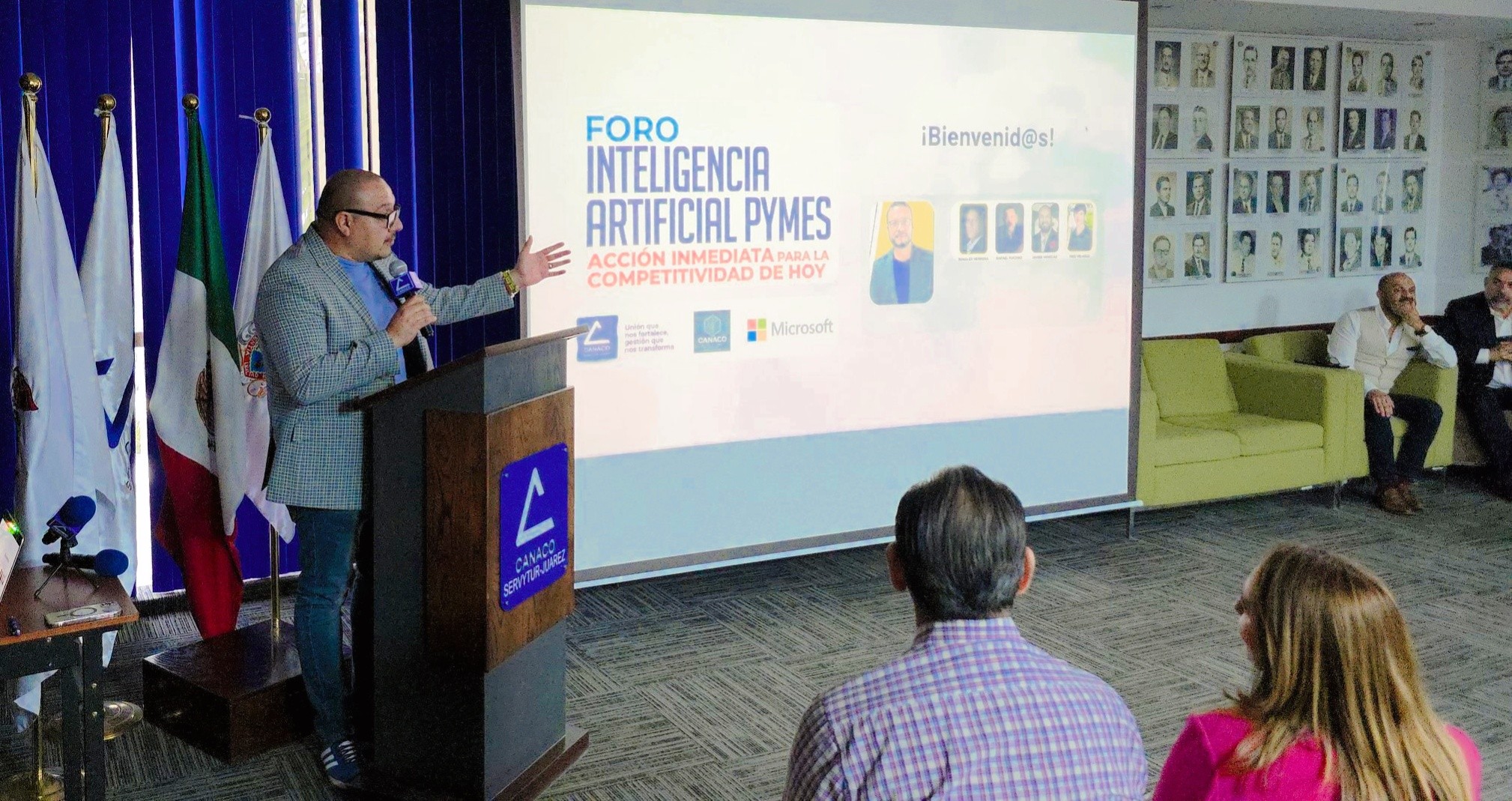
Omar Saucedo, Microsoft TechPark Regional Manager, opening the forum with a keynote on AI accessibility for SMEs. -
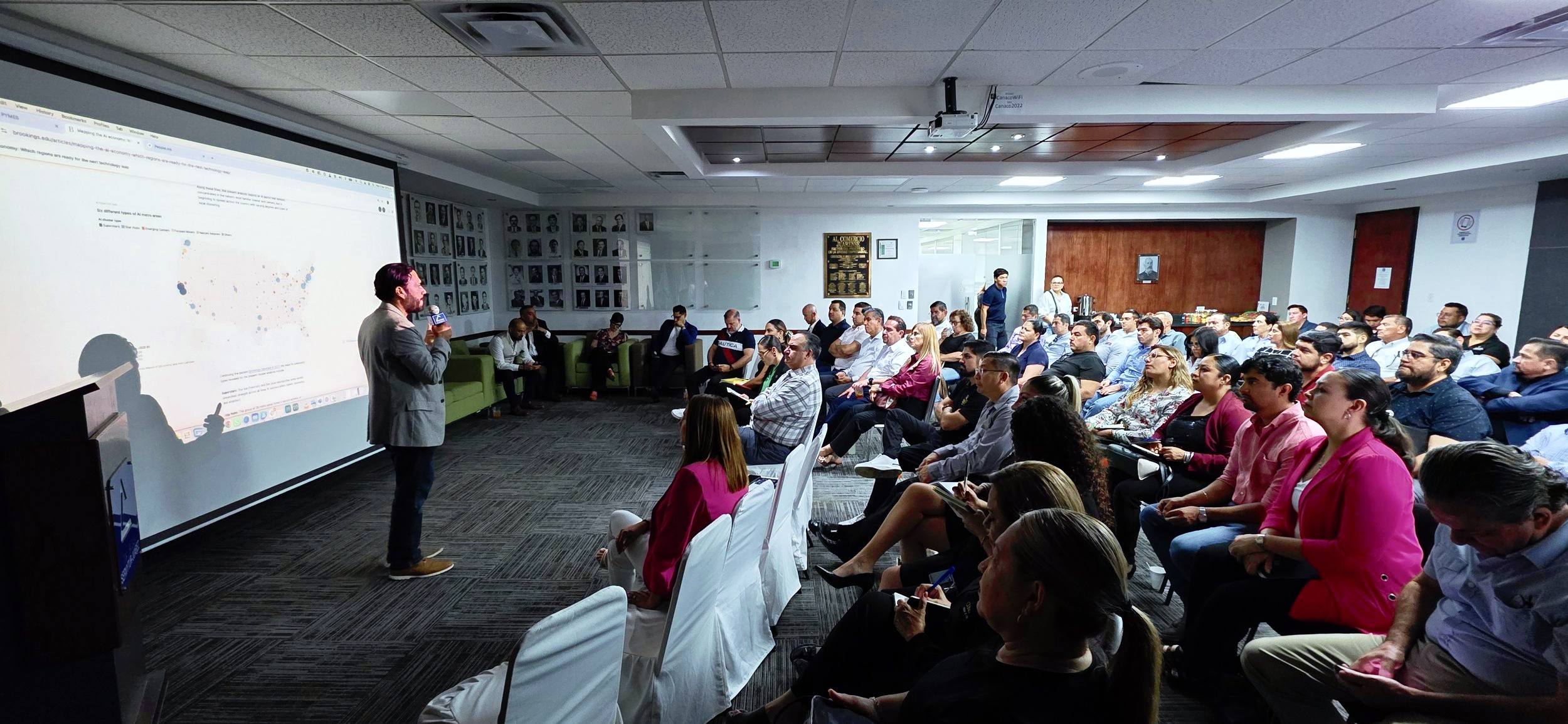
A full room of SME owners and operators. The attendance matters because it shows genuine demand for practical AI guidance in the region. -
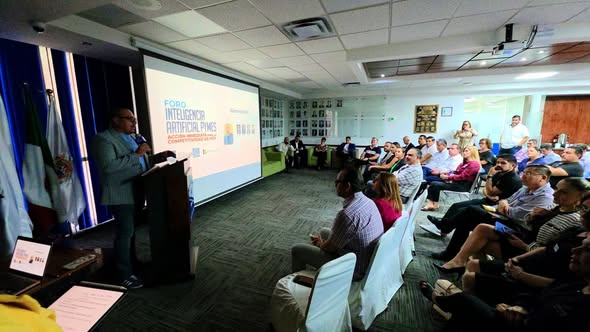
Wide angle showing the scale of engagement. This was not a panel for insiders but a room full of working business owners. -
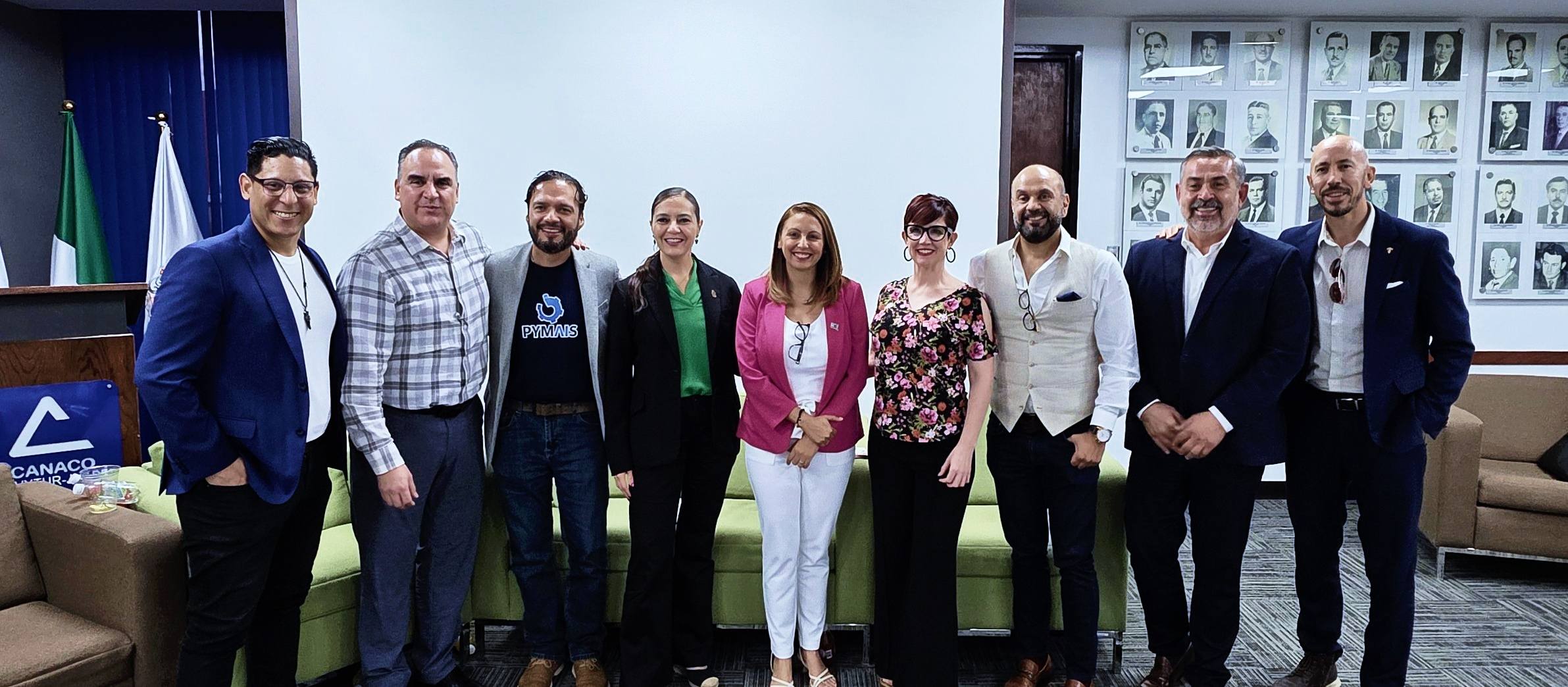
The speaker and organizer group, including representatives from CANACO, Microsoft, the Specialized Software Section, Desarrollo Economico, and FUNAX. -

Post-event press coverage from Ser Empresario amplified the forum's message beyond the room, reaching the broader regional business community. -
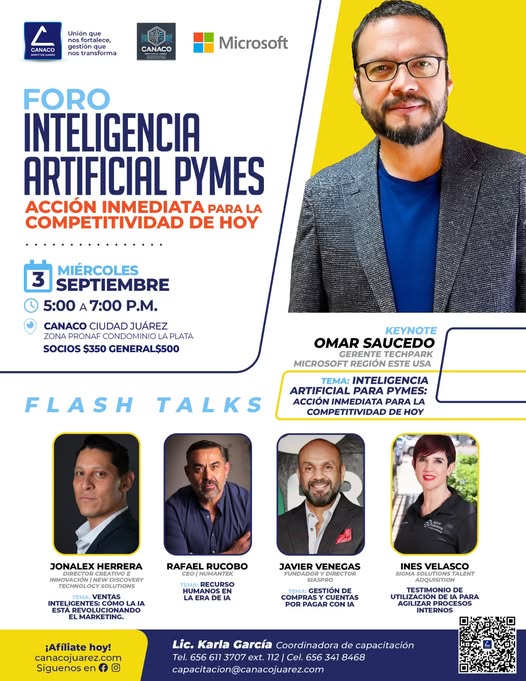
The official event poster showing the institutional backing from CANACO, Microsoft, and the flash talk lineup.
Slide 1 of 6
A first step for the region.
Not the last.
The strongest outcome was not a number but a shift. As Liz Pasillas, president of the Specialized Software Section, wrote after the event: "When we talk about technology from a human place, incredible things happen. Everyone agreed on something: AI is already here and can be a close, practical tool ready to help us transform our businesses."
The forum proved that regional AI adoption does not need to start with expensive pilots or enterprise contracts. It can start with a room full of business owners, a credible speaker, five focused presentations, and the institutional backing to make it feel real. That is exactly the kind of entry point Innovation is designed to create.
What this engagement reveals
about Innovation.
Innovation can operate inside institutional coalitions to deliver AI education that lands with non-technical audiences. This case shows content design, applied demonstration, and ecosystem positioning working together to make AI adoption feel achievable for small businesses.
That matters because AI readiness at the SME level is where the largest gap exists. Enterprise companies have budgets and teams. SMEs need someone to translate the opportunity into their language, inside their institutions, with their constraints in mind. This forum proved that model works.